
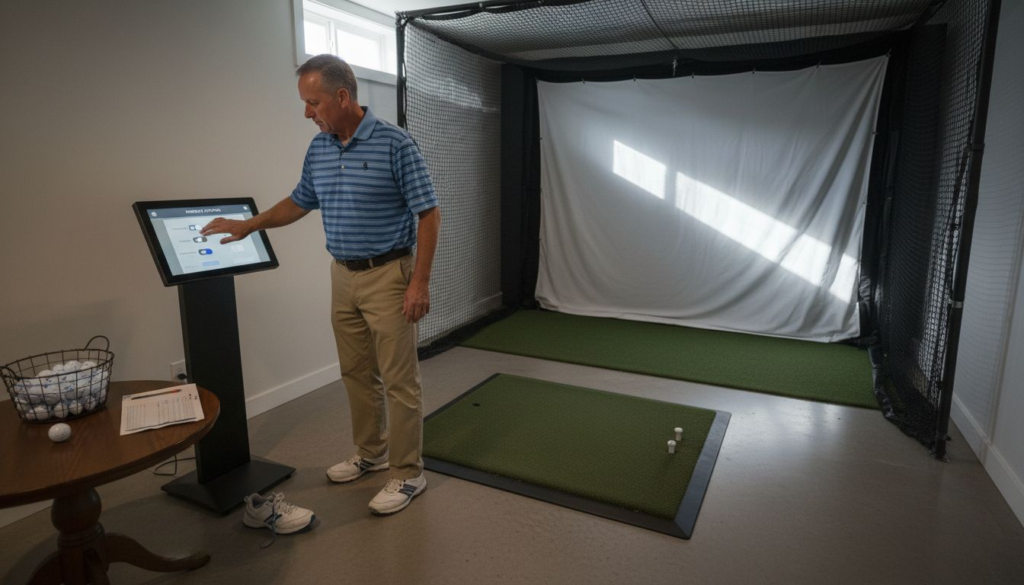
Enjoying a cutting-edge golf simulator at home can mean trading privacy for convenience without careful safeguards. As more Atlanta homeowners invest in advanced indoor golf experiences, concerns around personal data security are rising. Modern systems capture sensitive performance and biometric details, making robust privacy controls essential. With innovations like encryption and user consent frameworks, you can confidently pursue leisure while prioritizing digital privacy principles that keep your data protected.
Table of Contents
- Defining Golf Simulator Privacy Features
- Types of Privacy Controls and Technologies
- Data Collected by Golf Simulators
- Risks of Data Exposure and Mitigation Steps
- Integrating Privacy With Smart Home Systems
Key Takeaways
| Point | Details |
|---|---|
| Privacy Protections Are Essential | Modern golf simulators implement various privacy features to safeguard user data and ensure secure gaming experiences. |
| Understand Data Collection | Users should always review privacy settings to know what information is gathered and how it is used. |
| Mitigation of Risks Is Crucial | Proactive measures, including strong authentication and regular audits, are needed to protect against potential data breaches. |
| Integration with Smart Home Systems | Privacy in interconnected devices requires careful management to enhance user autonomy and security while maintaining functionality. |
Defining Golf Simulator Privacy Features
Privacy features for golf simulators represent sophisticated technological safeguards designed to protect users’ personal data and gameplay information. Digital privacy principles outline crucial protections that ensure sensitive user data remains secure during interactive gaming experiences.
These privacy mechanisms typically encompass multiple layers of protection, focusing on critical aspects of personal information management:
- Data Collection Control: Defining precisely what user information is gathered
- Access Management: Restricting who can view gameplay metrics
- Encryption Protocols: Securing transmission of personal performance data
- User Consent Frameworks: Providing transparent opt-in/opt-out mechanisms
Modern golf simulators integrate advanced privacy standards that align with international data governance guidelines. These standards ensure that every digital interaction within the simulator environment maintains rigorous confidentiality standards, protecting users from potential unauthorized data exposure.
Pro tip: Always review your golf simulator’s privacy settings and understand exactly what data is being collected before beginning your first gameplay session.
Types of Privacy Controls and Technologies
Golf simulator privacy technologies represent a sophisticated ecosystem of protective measures designed to safeguard user data and gameplay information. Privacy controls encompass a comprehensive range of organizational practices and technical tools that prevent unauthorized data exposure and maintain user confidentiality.
The key privacy control technologies in modern golf simulators include:
- Data Anonymization: Removing personally identifiable information from performance metrics
- Encryption Protocols: Securing transmission and storage of user data
- Access Management Systems: Restricting data visibility to authorized users
- User Authentication: Verifying user identity through multi-factor mechanisms
- Consent Management: Providing transparent opt-in/opt-out frameworks
Advanced golf simulator manufacturers are increasingly adopting privacy threat modeling frameworks to systematically identify and mitigate potential data risks. These frameworks help developers anticipate and prevent potential privacy breaches by analyzing potential vulnerabilities in the simulator’s digital infrastructure.

The following table summarizes how privacy technologies impact users and simulator operations:
| Technology | User Benefit | Simulator Function |
|---|---|---|
| Data Anonymization | Protects personal identity | Provides aggregated analytics |
| Encryption | Secures personal information | Safeguards data during transfer and storage |
| Access Management | Limits visibility to authorized users | Prevents unauthorized access to sensitive data |
| Consent Framework | Empowers user control | Ensures compliance with governance regulations |
Privacy-enhancing technologies transform golf simulators from simple gaming platforms into secure, user-controlled environments that prioritize personal data protection.
Pro tip: Always request a detailed privacy policy from your golf simulator manufacturer to understand exactly how your personal and performance data will be managed and protected.
Data Collected by Golf Simulators
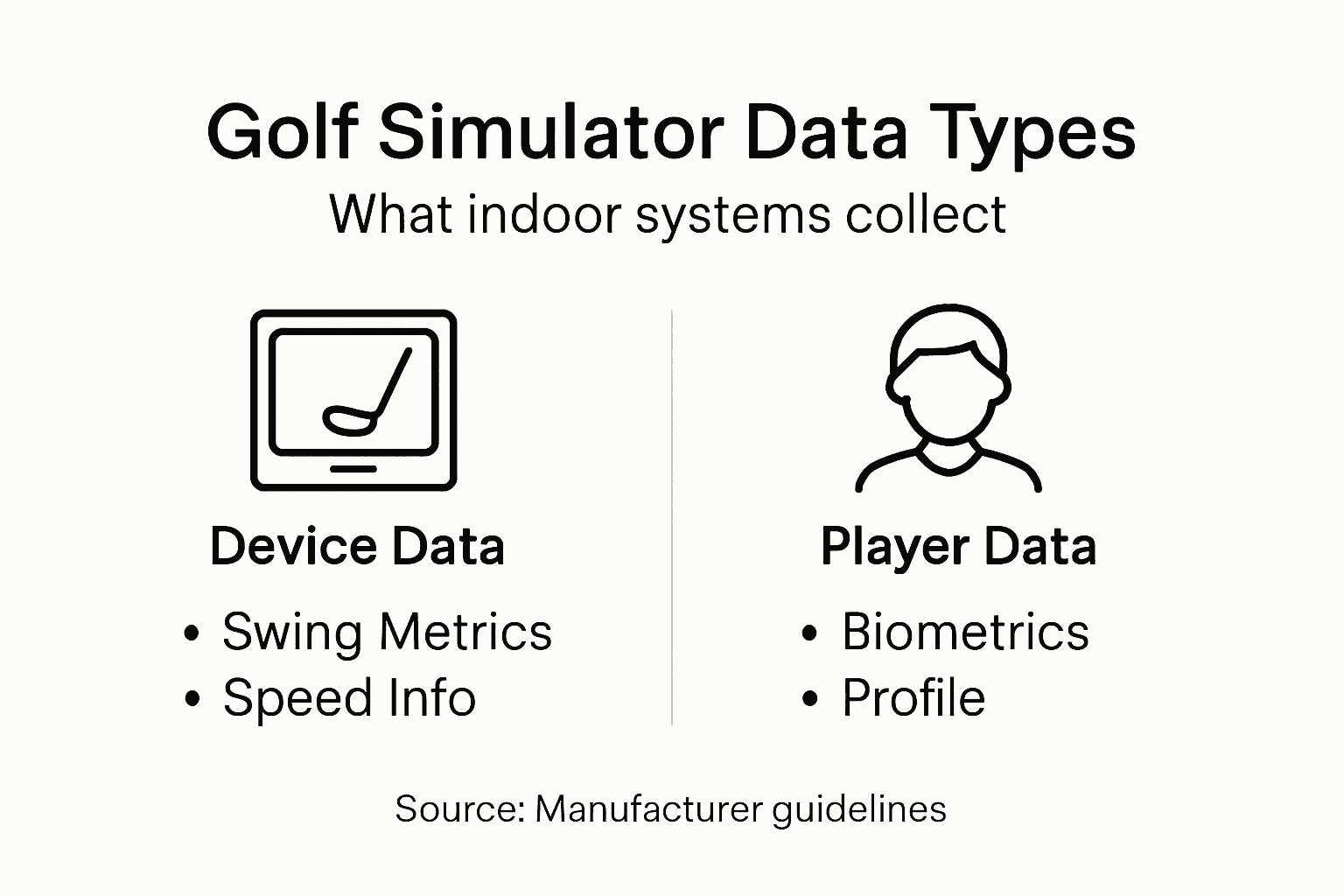
Golf simulators capture an extensive range of user data designed to enhance gameplay and provide comprehensive performance analysis. Digital tracking technologies enable these systems to collect sophisticated metrics that go far beyond simple score tracking.
The primary categories of data collected by modern golf simulators include:
- Swing Mechanics: Precise measurements of club speed, angle, and trajectory
- Ball Performance: Detailed tracking of ball spin, velocity, and launch characteristics
- Player Biometrics: Movement patterns, physical positioning, and muscle engagement
- Gameplay Statistics: Scoring, accuracy, distance, and comparative performance metrics
- Equipment Interaction: Club selection, usage patterns, and potential equipment recommendations
Golf simulator data collection represents a nuanced ecosystem where technological innovation meets personal performance analysis. These systems transform raw physical movements into actionable insights, providing players with unprecedented understanding of their golfing technique.
Advanced data collection technologies turn every swing into a learning opportunity, bridging the gap between recreational play and professional-level performance analysis.
Pro tip: Request a comprehensive overview of exactly what data your golf simulator captures to ensure you’re comfortable with the level of personal information being tracked.
Risks of Data Exposure and Mitigation Steps
Golf simulator technologies introduce complex privacy challenges that demand proactive risk management strategies. Privacy risks encompass multiple potential vulnerabilities that could compromise user data and personal information.
The primary privacy risks associated with golf simulators include:
- Unauthorized Data Access: Potential breaches exposing personal performance metrics
- Data Inference: Advanced algorithms generating unexpected insights from collected information
- Location Tracking: Potential geospatial data exposure through connected systems
- Equipment Profiling: Detailed insights about personal playing style and preferences
- Biometric Information Leakage: Potential misuse of physical movement and performance data
Responsible AI deployment requires implementing comprehensive mitigation strategies that protect user privacy while maintaining technological functionality. These approaches involve creating robust security frameworks that anticipate and neutralize potential data exposure risks.
Here’s a comparison of golf simulator privacy risks and effective mitigation strategies:
| Privacy Risk | Potential Impact | Mitigation Strategy |
|---|---|---|
| Unauthorized Data Access | Exposure of personal and performance data | Strong authentication and access controls |
| Data Inference | Unexpected insights from user data | Regular system audits and restrictions |
| Location Tracking | Disclosure of user movement or presence | Disable location access or use anonymization |
| Equipment Profiling | Detailed tracking of player habits | Limit retention and third-party sharing |
| Biometric Info Leakage | Misuse of motion and physical data | Encrypted storage and strict permissions |
Privacy protection is not about eliminating data collection, but about creating intelligent, user-controlled mechanisms that respect individual autonomy and data sovereignty.
Pro tip: Always request a comprehensive privacy impact assessment from your golf simulator manufacturer to understand potential data vulnerability points.
Integrating Privacy With Smart Home Systems
Privacy integration in modern smart home environments demands sophisticated technological approaches that balance functionality with user protection. AI-powered privacy tools enable homeowners to create granular control mechanisms for their interconnected digital ecosystems, ensuring comprehensive data management across multiple devices.
Key strategies for seamless privacy integration include:
- Context-Aware Settings: Dynamic privacy controls that adjust based on user activity
- Transparent Data Notifications: Real-time alerts about data collection and usage
- Local Data Processing: Minimizing external data transmission
- Consent Management: User-controlled permission frameworks
- Encryption Layers: Robust security protocols for device communications
Smart home privacy frameworks require comprehensive approaches that prioritize user autonomy while maintaining technological sophistication. These systems transform privacy from a passive concept into an active, user-controlled mechanism.
Privacy is not about eliminating technology, but about creating intelligent systems that respect individual boundaries and preferences.
Pro tip: Conduct a quarterly review of your smart home system’s privacy settings to ensure ongoing protection and alignment with your personal comfort level.
Secure Your Indoor Golf Experience with Expert Privacy Solutions
Protecting your personal data and gameplay details is as important as perfecting your swing. The article highlights challenges like unauthorized data access and biometric information leakage that come with golf simulators. At Atlanta Home Theater, we understand the crucial role advanced privacy features play in creating a secure and immersive golf simulator environment. Our team integrates state-of-the-art encryption protocols, access controls, and user consent frameworks to ensure your data stays private and your experience remains seamless.
If you want to combine cutting-edge technology with trusted privacy safeguards for your home golf simulator, explore our expert guidance in the Sound Advice Archives – Atlanta Home Theater and discover tailored solutions that meet your privacy expectations. Take control of your indoor game privacy today by scheduling a personalized consultation at Atlanta Home Theater. Protect your performance data and enjoy every swing with confidence.
Frequently Asked Questions
What privacy features should I look for in a golf simulator?
When choosing a golf simulator, look for privacy features such as data collection control, encryption protocols, access management systems, and user consent frameworks to ensure your personal information is protected.
How does data anonymization work in golf simulators?
Data anonymization involves removing personally identifiable information from performance metrics, which helps protect your identity while still allowing the simulator to provide aggregated analytics for your gameplay.
What types of data do golf simulators typically collect?
Golf simulators typically collect data on swing mechanics, ball performance, player biometrics, gameplay statistics, and equipment interaction to enhance gameplay and provide in-depth performance analysis.
What steps can be taken to mitigate privacy risks associated with golf simulators?
To mitigate privacy risks, implement strong authentication and access controls, conduct regular system audits, limit data retention, and ensure encrypted storage of personal and performance data.
Recommended
-
- Golf Simulator User Interface Explained: Smarter Indoor Play – Atlanta Home Theater
- Golf Simulators: How Technology Recreates Real Courses – Atlanta Home Theater
- 7 Key Golf Simulator Benefits for Smart Homeowners – Atlanta Home Theater
- Golf Simulation Family Rooms: A Complete Guide – Atlanta Home Theater