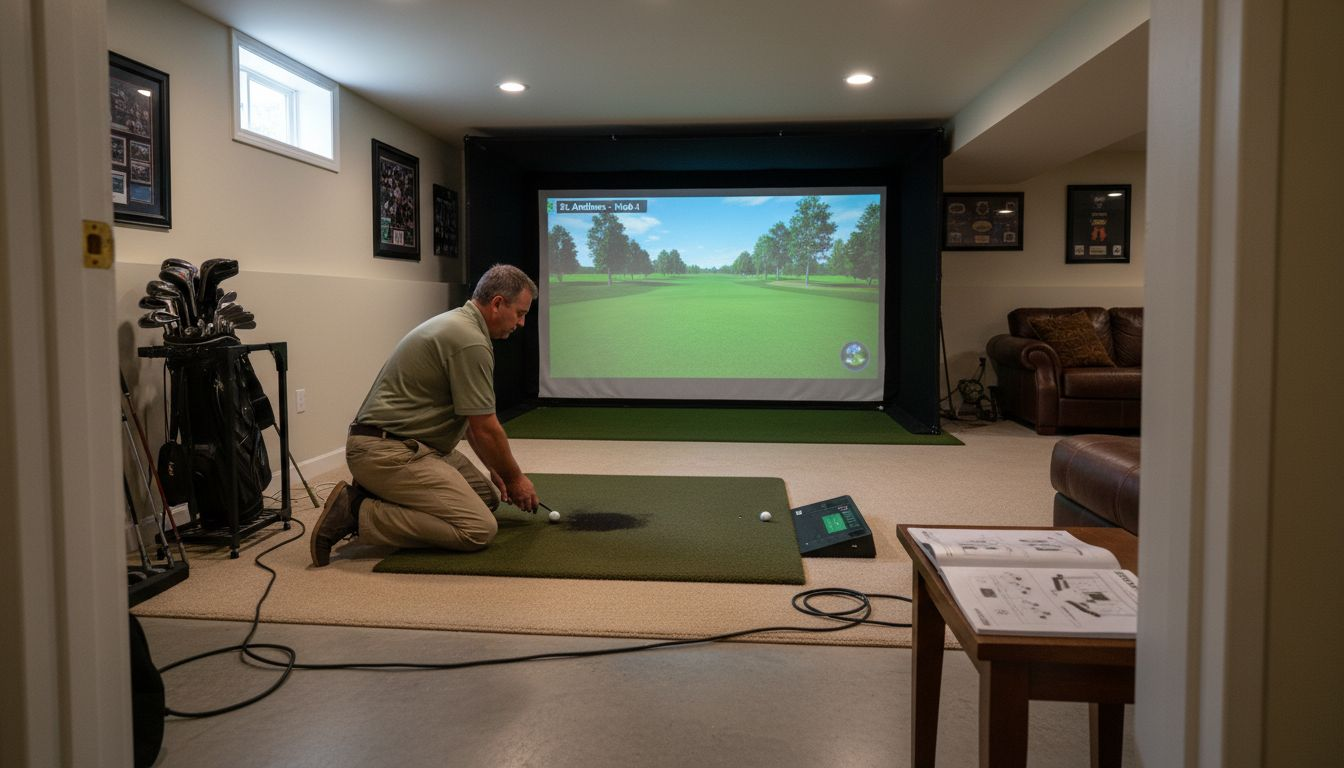
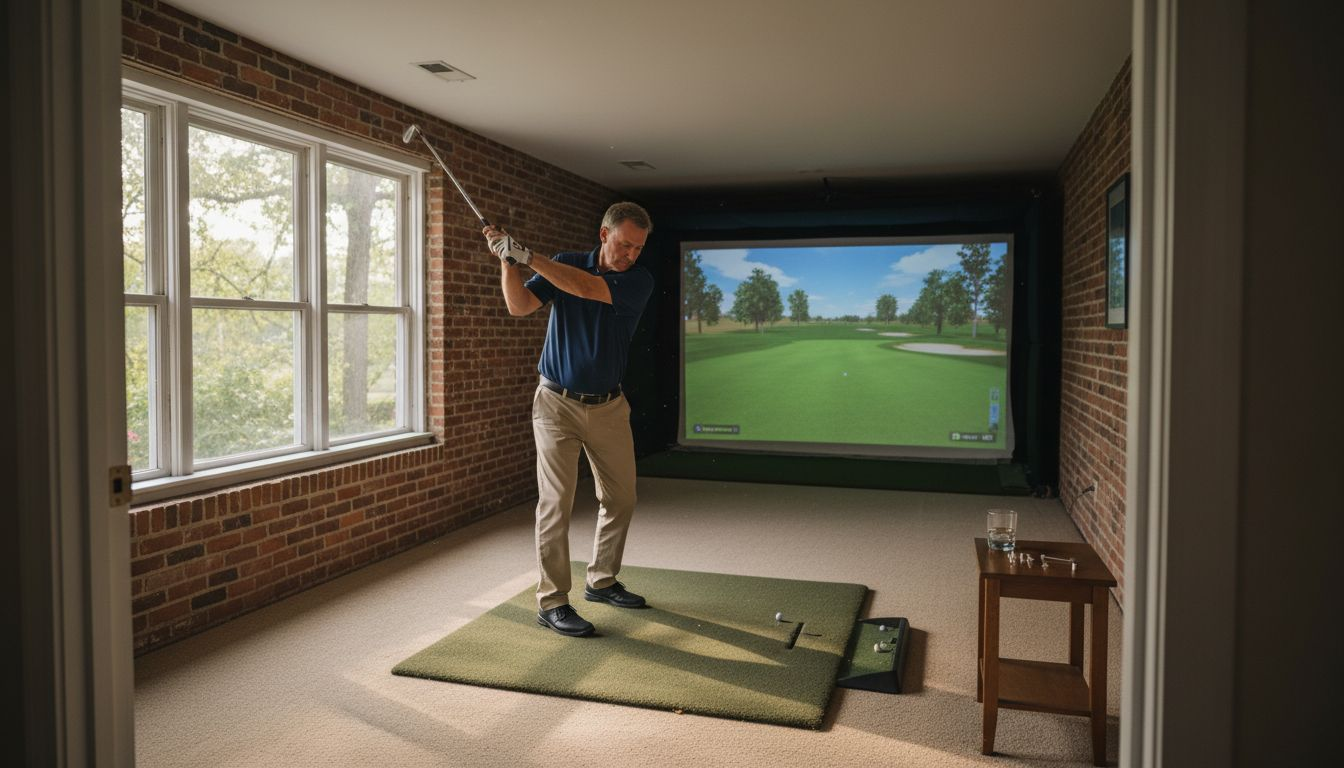
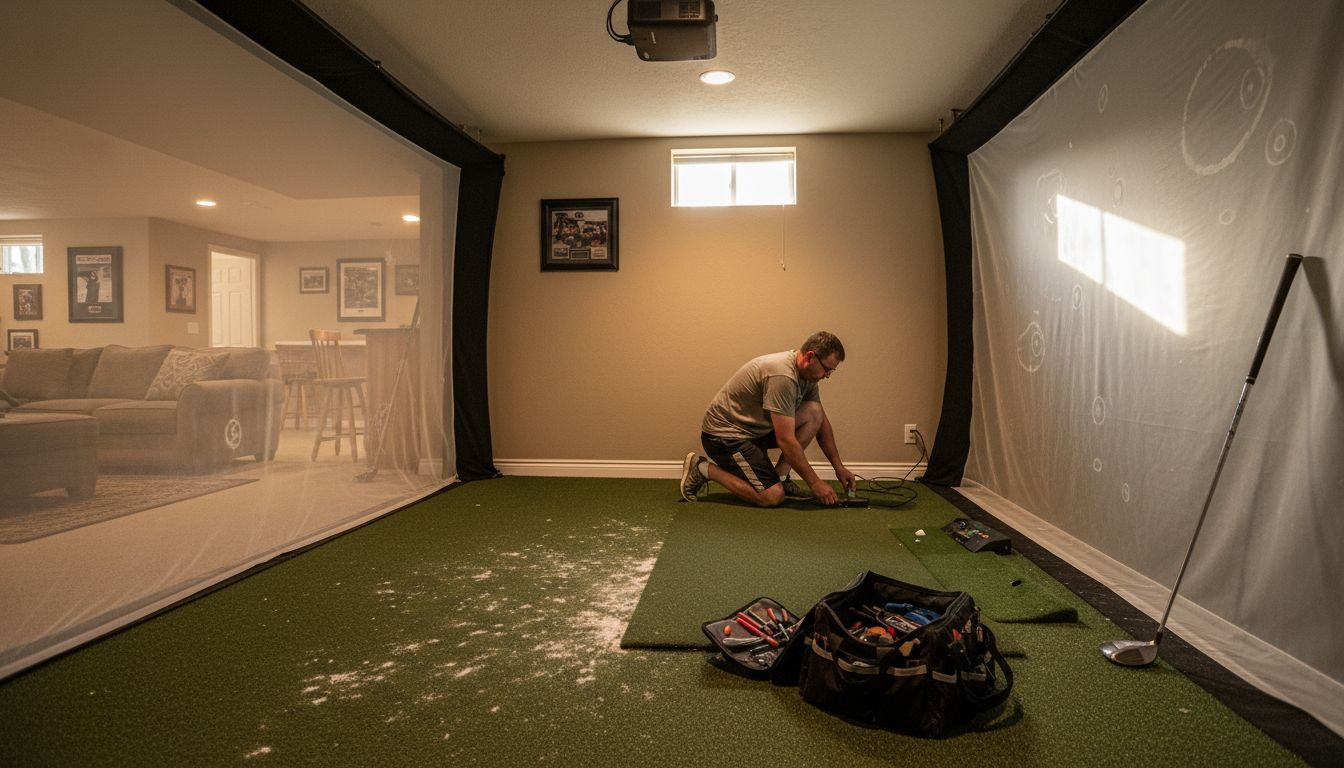
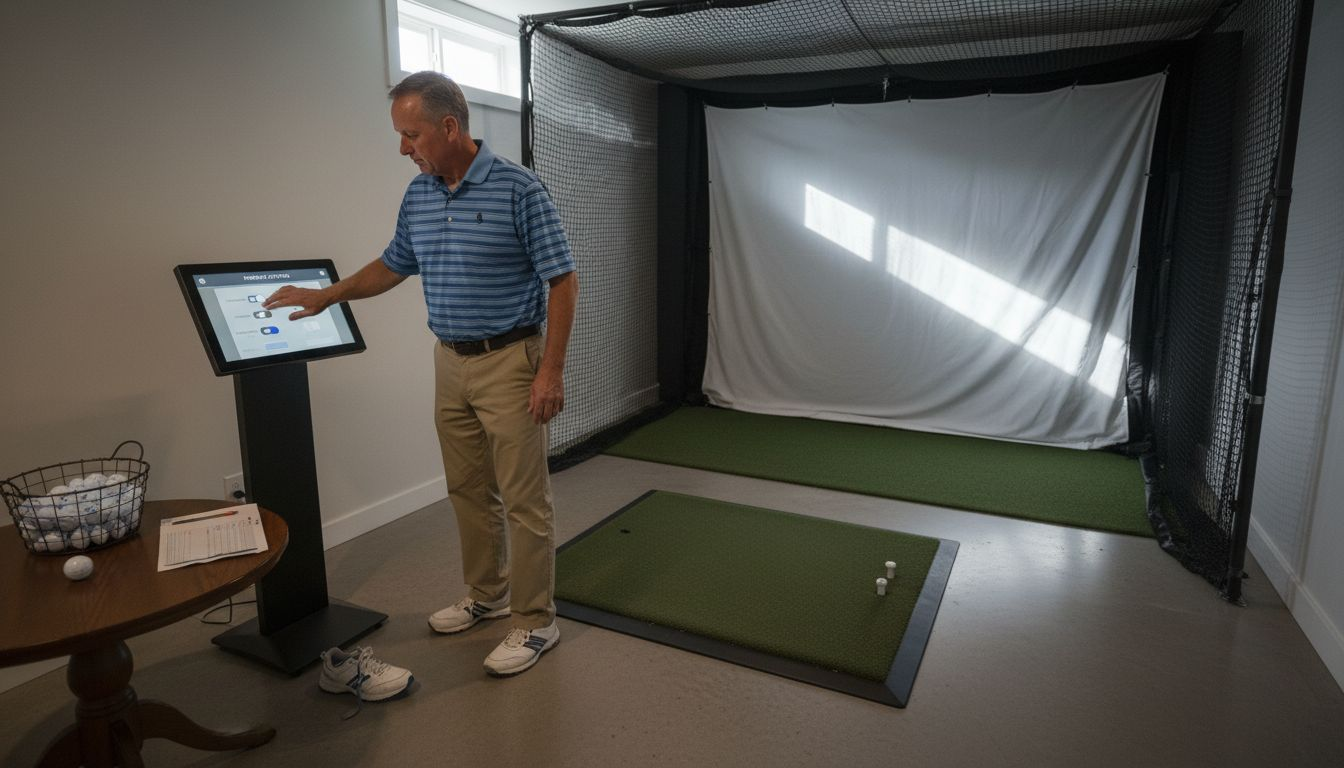
Finding the ideal golf simulator projector for your home can feel overwhelming when precision and visual realism are equally important. These specialized systems are not just about entertainment—they transform your space into a high-fidelity training environment, blending immersive course imagery with accurate performance tracking. With features like high-resolution displays and advanced sensor integration, the right projector elevates both your home theater and your golf game. Discover how thoughtful selection and placement make all the difference.
| Point | Details |
|---|---|
| High Luminosity and Resolution | Select a golf simulator projector with at least 3500 lumens and 1080p or 4K resolution for optimal imaging and realism. |
| Short Throw Projection Benefits | Consider a short throw projector for compact spaces, enabling large image projection from minimal distances without shadows. |
| Comprehensive Sensor Integration | Choose a simulator that includes advanced sensor technologies for detailed performance tracking and analysis. |
| Budget for Future Upgrades | Plan for ongoing maintenance and allocate 10-15% of your initial investment annually to ensure system performance and technology updates. |
A golf simulator projector represents far more than a standard home entertainment device. These specialized optical systems are engineered to transform indoor spaces into immersive golfing environments by delivering hyper-realistic course simulations and precise performance tracking. High-definition golf course projections enable homeowners to experience world-class golf venues without leaving their personal spaces.
The core characteristics of a sophisticated golf simulator projector encompass several critical technological elements:
Beyond visual performance, these projectors integrate seamlessly with launch monitor technologies that capture intricate ball flight data. Precise ball tracking sensors analyze spin rates, trajectory, club head speed, and impact dynamics – transforming a simple projection into an interactive training experience.
Pro tip: Invest in a projector with at least 3500 lumens and verify its compatibility with popular golf simulation software to maximize your home golf experience.
Golf simulator projectors come in three primary configurations, each offering unique advantages for home enthusiasts seeking the ultimate indoor golfing experience. Projector throw ratios) play a critical role in determining which model best suits your home golf setup, with each type presenting distinct installation and performance characteristics.
The three primary projector categories for golf simulators include:
Ultra-short projection technologies have dramatically transformed golf simulator installations, enabling homeowners with limited space to create immersive training environments. These advanced projectors can generate massive screen images from just inches away, eliminating traditional placement constraints.
Here’s a quick comparison of popular golf simulator projector types and their optimal use cases:
| Projector Type | Ideal Room Size | Key Advantage | Best For |
|---|---|---|---|
| Short Throw | Compact spaces | Easy installation, minimal shadows | Apartments, small homes |
| Standard Throw | Large rooms | Flexible placement, greater distance | Dedicated simulation rooms |
| 4K Ultra HD | Any size | Stunning detail, immersive visuals | Enthusiasts, training setups |
Pro tip: Measure your available room space precisely before selecting a projector, considering both throw distance requirements and screen dimensions to ensure optimal simulator performance.
Advanced golf simulators transcend simple entertainment, representing sophisticated training systems that meticulously recreate real-world golfing experiences. Tri-tracking sensor technologies enable precise ball and swing analysis by combining multiple data capture methods, transforming home spaces into professional-grade training environments.
The critical components for high-fidelity golf simulation include:
Advanced launch monitor systems provide granular insights into every aspect of a golfer’s performance, capturing nuanced data points that were previously impossible to measure in home environments. These sophisticated systems bridge the gap between casual practice and professional-level training.
Pro tip: Select a simulator with comprehensive sensor integration and software compatibility to ensure you can track and improve multiple aspects of your golf performance.
Creating the perfect home golf simulator demands meticulous spatial planning and strategic equipment positioning. Golf simulator room configurations require careful consideration of ceiling heights, swing clearance, and projector throw distances to ensure an optimal indoor golfing experience.
Key spatial considerations for simulator setup include:
Advanced simulator placement techniques emphasize the importance of creating a dedicated space that balances technological requirements with functional ergonomics. Precise projector positioning can transform even compact rooms into immersive golf training environments.
Pro tip: Measure your available space precisely, including ceiling height and potential swing path, before investing in a golf simulator to ensure compatibility with your chosen equipment.
Investing in a home golf simulator represents a significant financial commitment that extends beyond initial purchase price. Simulation project complexities reveal intricate challenges involving technological integration, component durability, and long-term performance sustainability that homeowners must carefully evaluate.
The key cost and longevity considerations include:
Golf simulator technology investments demonstrate that higher upfront costs often correlate with improved long-term reliability and performance. Professional installation and periodic maintenance can significantly extend the functional lifespan of sophisticated simulation systems.
Below is a summary of major investment factors to consider for a home golf simulator:
| Expense Category | Typical Cost Range | Long-Term Consideration |
|---|---|---|
| Projector Hardware | $800 – $5,000+ | Replacement cycles, tech upgrades |
| Launch Monitor | $1,500 – $7,000+ | Sensor maintenance, calibration |
| Software | $300 – $2,000+ | Annual updates, compatibility |
| Installation/Room Mods | $500 – $5,000+ | Space longevity, layout flexibility |
Pro tip: Budget for ongoing maintenance and potential technology upgrades, allocating approximately 10-15% of your initial investment annually to ensure continued system performance and relevance.
Choosing the right golf simulator projector can feel overwhelming due to complex throw distances, projector types, and space constraints. The article highlights common challenges like matching short throw projectors to compact rooms and ensuring sensor compatibility for accurate ball tracking. If you want to avoid pitfalls such as poor image quality, shadow interference, or costly integration issues you need a solution designed for your unique space and performance goals.
At Atlanta Home Theater we specialize in creating immersive golf simulators that combine advanced projector technologies with seamless smart home integration. Our experienced team understands the critical factors like projector placement, high luminosity requirements, and sensor system synchronization that bring your simulator room to life. Explore expert insights and inspiration in our Sound Advice Archives – Atlanta Home Theater and let us help you select the perfect setup for your home.
Ready to transform your space with a professionally designed golf simulator that maximizes performance and style Visit Atlanta Home Theater today Schedule your personalized consultation to unlock unparalleled golf experiences without stepping outside your door.
Short throw projectors are ideal for compact spaces as they require minimal installation distance, reducing shadows and installation complexity. This makes them perfect for apartments and smaller homes.
4K projectors provide ultra-high resolution imagery with superior visual fidelity and enhanced color reproduction, allowing for maximum detail in course simulation, elevating the overall immersive experience.
When measuring space, consider vertical clearance requirements (minimum 9-foot ceiling height), horizontal dimensions (recommended depth of 15-20 feet and minimum 10-foot width), and ensure unobstructed hitting zones for full range of motion.
Key cost factors include the initial investment in hardware such as a projector and launch monitor, software expenses, installation costs, and potential custom modifications to the room layout.
Just a few short years ago, my daughter and I were at a point in our lives where we didn’t know what the future would look like. With high rent and utilities, we were barely making it from week to week. There was never enough left over to save money, and sometimes even basic things like buying new clothes when we needed them felt out of reach. Today, everything has changed because we now have our Habitat home, and it has truly been a blessing.
Becoming a Habitat homeowner has given me something I didn’t have before—stability and peace of mind. I no longer live with the constant worry of whether we’ll make it through the next month or how I would handle unexpected expenses like car repairs or new tires. Having a safe, affordable home has lifted a huge weight off my shoulders.
We also couldn’t ask for a better neighborhood. Our neighbors are wonderful people, and there is a real sense of community here. If I ever need help, all I have to do is ask. My daughter loves our new home. She loves our neighbors, and she is happy at her school. Seeing her feel safe and proud of where we live means everything to me.
Our Habitat home has given us more than just a house—it has given us hope, stability, and a place where our family can truly grow and thrive.
Thank you, Habitat, for changing our lives.
Jason & Kaitelyn “KK” Criag
Hi to all of our Habitats friends and family! I am April Joines, a Habitat homeowner of six years now. When we began this journey in 2019 with Habitat NCG, we didn’t know the full impact that owning a Habitat House would make on our lives. Our children were 2,3,6 and 8 at the time and we were struggling to find a place to live.
Although, my husband and I are both college graduates and worked full time jobs, we were unable to afford the rising cost of homes in the north central Georgia.
The high cost of rent was increasing and with four young children we were more than struggling. Since moving into our home in January of 2020, we have grown and changed so much.
We all know that a house is more than a place to sleep at night- it’s a refuge, a place of safety for our children, a place that is our own. The security that providing a safe environment to live in cannot be overstated.
Not just for children but for parents, grandparents or anyone that has known the struggle of homelessness or a dire living situation. The freedom to live life to the fullest without worrying about the roof over our heads is priceless.
We have continued to grow as individuals and as a family unit, and we are better for the experience we have had with Habitat. We’ve met many people along the way and have worked with some of the best people in the world!
Today our kids are 9,10, 13 and 15 They are thriving and they truly love our little home. When thinking back on the last five years, while it hasn’t always been easy or perfect, we can truly say we are healthier and happier because Habitat gave us the hand up that we desperately needed.
Financial stability and peace begin with the four walls we call home. God has always taken care of us and continues to. Maya Angelou said, “The ache for home lives in all of us”. She was referring to the deep, innate human desire for a place of belonging and comfort. This is part of the fundamental human experience.
This is a necessary and good work. To all the Habiatat NCG staff, partners, sponsors and volunteers-thank you! We are grateful for you, and we cheer you on as you continue to do this good work.
Jake, April, Leslie, Landon, Lillian and Luke Joines
A few years ago, I found myself in quite the unfortunate situation. I was on the verge of being evicted from my apartment. After almost losing my newborn daughter to apnea, I was unable to go back to work because no daycare wanted the liability that came with an infant who was hooked to an apnea monitor day and night. While St. Andrew was gracious enough to pick up the tab for my day-to-day expenses including the rent for my apartment, that was not a sustainable solution and I was constantly afraid that the rug would be pulled from under me and I would be homeless, again. That was my biggest fear. You see, I had already experienced homelessness before when I left an abusive marriage and ended up in a battered women’s shelter.
It was through my caseworker at St. Andrew that I found out about Homestretch, a transitional housing program that guides homeless working families towards stable housing, which means that clients must be employed full time. You may wonder how a person can be employed full time and be homeless. I will tell you how. When you are making $9 an hour with two children under the age of three in day care, your biweekly paycheck is not even enough to cover a week of safe childcare in North Fulton. Ironically, I started working at a high-end day care where even with 50 % employee discount; I could still not afford to enroll my children there.
I moved into a Homestretch unit in July of 2007. Unlike the shelter, Homestretch treated my situation with the respect, dignity, and the self-worth that my daughters and I deserved. It was during one of the mandatory life skills classes that I found out about Habitat. A representative from Habitat had been invited to come and speak about habitat and the eligibility criteria for a home. The thought of being able to provide permanent housing for my young daughters had seemed like a distant dream but this information from Habitat showed me that owning a home could become a reality for me.
First order of business was to find a suitable job to meet the income eligibility. I registered with employment agencies with the goal of getting a job in my field of study, accounting. After several short-term placements, I was finally able to secure a fulltime position with a nonprofit organization in Atlanta. With a job sorted out, next on my agenda was cleaning my credit report. Health setbacks of my own had left me with almost $200,000 in medical debt. I worked with my budget advisor to manage my finances and figure out a way to pay off my medical debt. The goal was to clean up my credit report and raise my score which was at an all-time low of 383. This meant that I was held accountable and had to justify every purchase I made. My family mentor became a sounding board for the many times things seemed to be falling apart and I just wanted to give up.
Together, the budget advisor and family mentor supported me and were instrumental in helping me apply for hospital charity to pay off most my debt as well as apply for welfare to help with food and childcare expenses. They also helped me negotiate lower payments for the smaller bills with debt collection agencies. Having made some significant strides towards financial security, I applied for a habitat home for the first time in 2008. While I did not qualify for a home that year, the Habitat liaison with Homestretch gave me pointers and highlighted areas of improvement that would increase my chances for qualifying. Yes, I was disappointed, but I was also more determined to do what was needed so I would have a strong application the following year.
In the end, after almost four years at Homestretch, I was able to pay off my medical debt, save some money, find a better job, and build up my credit score all of which helped me qualify for a habitat home in 2009. I still vividly remember the call from my caseworker to tell me that I had been approved for a home. I cried, I laughed, I was lost for words. Finally, my daughters and I would be able to move into our own home without fear of being homeless again. I remember the anxiety of waiting for my build, wondering if something would happen before then and I would lose this once in a lifetime opportunity for homeownership.
Thankfully, nothing happened and in June of 2010, I hammered in that first nail with great joy and pride. 300 sweat equity hours and ten financial literacy classes later, I moved to my newly built habitat home in December of 2010. I didn’t sleep a wink that first night as I was still in a state of disbelief. My own home, complete with a garage and a washer and drier and other appliances. But the significance of that first day was captured in a question my then six-year-old asked ‘now can I learn my address?’ You see, her kindergarten class was learning about home addresses and since we were in transition, I had promised her that once we moved to our new home, I would teach her our address.
In the years since moving into our habitat home, I have achieved other milestones which have only been possible because I had the most important thing for a family, a safe and secure home. In 2015 I became a naturalized US citizen and in 2016, I graduated with my master’s in public administration.
Today, I am employed as Senior Accountant of a nonprofit that serves vulnerable individuals, and I perform my duties with the same zeal that I witnessed in the Habitat staff and volunteers. Recognizing that a helping hand to someone who has been beaten down by life can make all the difference. My daughters are 20 and 18 now and are doing great. One is a sophomore at the University of Alabama and the other is a senior at St. Pius Catholic High School. And that credit score is now to 819.
I am where I am today because Homestretch and habitat offered me something that homeless families often don’t get – a hand up to improve my situation while keeping my self-worth intact. My prayer is that those of you present here today will continue to support this wonderful organization so someone else in my situation can get a break, a chance to succeed. And from the bottom of my heart, I want to say thank you. Thank you for giving me stable housing and thank you for the gift of home ownership. I do not exaggerate when I say that every time I make a turn into my driveway I thank God for Habitat.
Thank you!

Hello my name is Tia Merriweather. Habitat homeowner since 2005.
Reflecting back over the past 20 years of what being a habitat homeowner has meant to me. It has meant accomplishing goals of being able to own, maintain affordable, decent and safe housing for my family to achieve our personal and family goals.
My goal as a mother has always been to provide my children with housing in a safe neighborhood, great educational opportunities and being active contributors to a community.
Becoming a homeowner with Habitat North Georgia provided our family the opportunity to achieve these goals by:
Owning a home that was affordable, maintainable, and safe to live in.
Homeownership allowed my children to have their own home. Providing stability for them to be grow personally, educationally and socially.
The impacts of having stable housing allowed my children to attend and graduate from highly reputable North Fulton schools, resulting in them continuing their education at a collegiate level.
The collegiate accomplishment included myself as well, with obtaining a BA in Communication in 2021 and becoming a life coach.
Achieving my goals of community involvement as a homeowner has included me being a past volunteer with Habitat as a mentor for new homeowners as they navigate the process of becoming a new homeowner.
Volunteering with local organizations to provide life coaching to individuals in metro Atlanta.
Our family is grateful that we were blessed to be recipients of the habitat for humanity homeownership program to help our family achieve our family and personal goals.
Thank you Habitat For Humanity.