Every Atlanta homeowner aspiring to build a luxurious home theater faces one big question: how do you create an experience that truly immerses every guest, not just adds another screen to your space? Understanding your room’s layout and defining your precise entertainment goals are the foundation for every successful project. From
contextual factors like room size and layout to the seamless integration of smart automation, this guide offers the practical insights you need to craft an immersive, beautiful, and intelligently connected home theater.
Table of Contents
Quick Summary
| Key Takeaway |
Explanation |
| 1. Assess Space Before Equipment |
Measure dimensions and consider factors like light, layout, and acoustics for optimal setup decisions. |
| 2. Define Clear Entertainment Goals |
Specify the primary use and features needed for your space to guide equipment choices effectively. |
| 3. Balance Audio and Visual Investments |
Allocate budget evenly between audio and video to ensure a truly immersive experience; audio quality is crucial. |
| 4. Integrate Smart Home Automation |
Create a unified smart system to enhance convenience, automating lighting, audio, and environmental controls seamlessly. |
| 5. Systematically Test and Optimize |
Conduct thorough testing of all components and gather feedback for iterative adjustments to improve the viewing experience. |
Step 1: Assess Space and Define Entertainment Goals
Before selecting a single projector or sound system, you need to understand your space and what you actually want from your theater. This step determines everything that comes next—technology choices, budget, and even the overall experience quality.
Start by measuring your room precisely. Note the dimensions, ceiling height, and existing architectural features like columns, windows, or awkward angles. Understanding contextual factors including size and layout is critical because they directly impact sight lines, sound distribution, and equipment placement.
Walk through your space at different times of day. How much natural light enters? Where are the electrical outlets? What’s the wall condition? In Atlanta’s humid climate, moisture management becomes relevant too. These practical details prevent expensive mistakes later.
Now define your entertainment goals. Are you building a dedicated cinema for serious film viewing, or a multipurpose room for gaming, sports, and movies? The distinction matters greatly. Your goals should address:
- Who will use the space and how frequently
- What content you’ll primarily watch or experience
- How often you’ll entertain guests
- Whether you want advanced features like gaming or simulation capabilities
- Your timeline and budget constraints
Clearly defining objectives that drive content and technology choices ensures you invest in equipment that actually serves your lifestyle. An Atlanta homeowner who hosts frequent gatherings needs different solutions than someone seeking personal cinema escapes.
Write these goals down. Specificity wins. “Watch movies” is vague. “Host monthly movie nights for 8-10 friends plus play competitive gaming monthly” is actionable and guides every decision forward.
Here’s how dedicated home theaters and multipurpose media rooms differ in key areas:
| Aspect |
Dedicated Home Theater |
Multipurpose Media Room |
| Main Use |
Movie and film viewing |
Gaming, TV, events, movies |
| Seating |
Fixed, theater-style |
Flexible, casual furniture |
| Lighting |
Controlled, minimal windows |
Natural light often present |
| Audio |
Tuned for immersion |
Focus on versatility |
| Equipment Placement |
Built-in and concealed |
Freestanding or modular |
| Budget Focus |
Prioritized on AV performance |
Balanced across features |
Your space assessment and goal definition directly determine the success and value of your entire immersive theater investment.
Once you understand your space and priorities, you’re ready to explore how different
media room design approaches align with your specific situation.
Pro tip: Take photos and video of your space from multiple angles, then share them with professionals during consultations—this accelerates the design process and ensures recommendations fit your actual environment, not an imagined one.
Step 2: Select Advanced Audio and Visual Solutions
Your space is assessed and goals are defined. Now comes the exciting part: choosing technology that transforms your vision into reality. The right audio and visual equipment makes the difference between a nice room and a genuinely immersive theater.
Start with your display. For a luxury home theater, you’re typically choosing between a high-quality projector paired with a motorized screen, or a large television. Projectors deliver the cinematic experience most people desire, but they require room darkness and proper mounting. Televisions offer brightness, convenience, and excellent for smaller spaces or rooms with windows. Consider your primary use case from Step 1—what content demands the best visual quality?
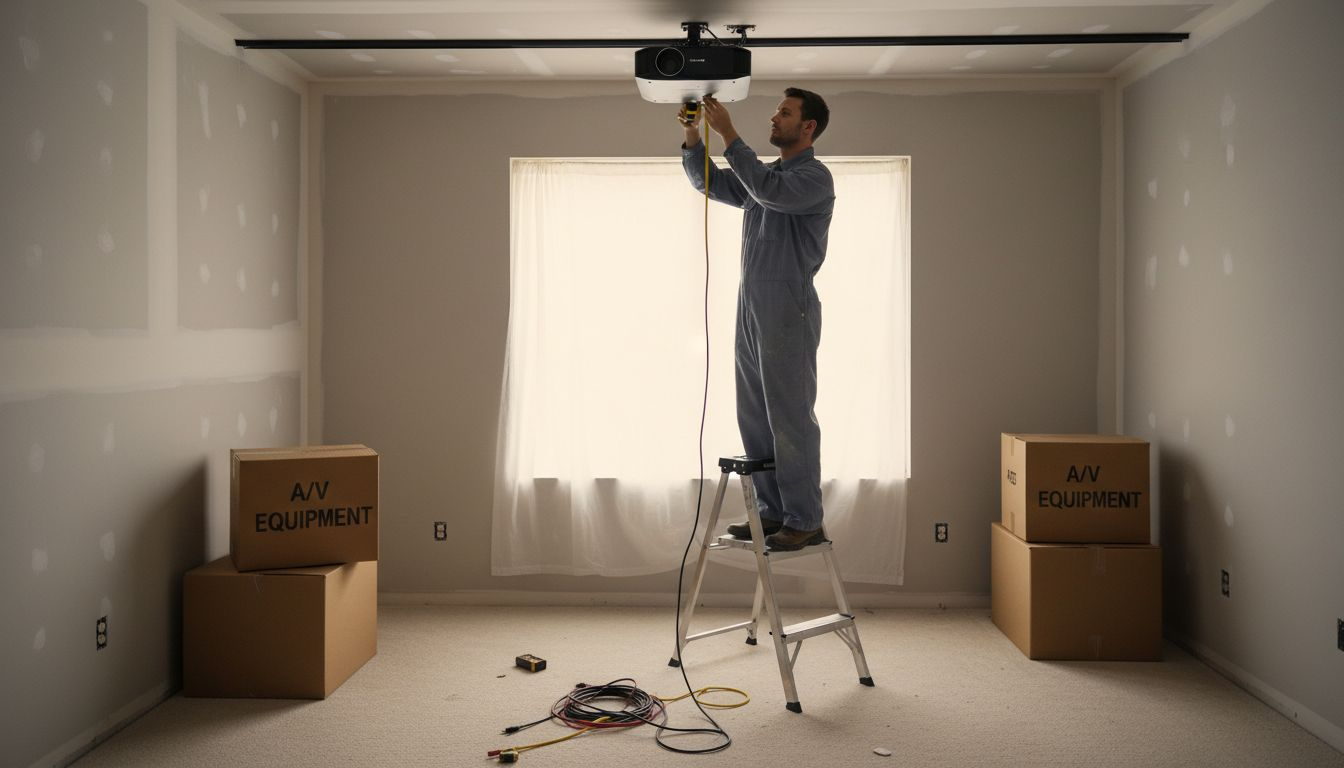
Projector selection depends on brightness, resolution, and throw distance. A 4K projector with at least 2,500 lumens handles darker rooms well. If you have some ambient light, aim for 3,500 lumens or higher.
Equipment capable of engaging multiple senses creates the immersion you’re after.
Next, evaluate audio solutions thoroughly. This is where most homeowners underinvest, then regret it immediately. Your audio setup needs to match your visual quality. Consider these components:
- Surround sound configuration (at minimum, 5.1 channels for immersion)
- Subwoofer power and placement for realistic bass response
- Ceiling speakers if you’re going fully immersive with Dolby Atmos
- Acoustic treatment to control reflections and room modes
- Quality amplification to drive your speakers properly
Immersive audio systems create dramatic improvements in how movies, games, and music feel. The difference between standard surround sound and true immersive audio is profound—you’ll hear objects moving overhead and around you in three dimensions.
Balance your budget across both domains. A $15,000 projector paired with a $2,000 audio system creates frustration. Invest proportionally. Many successful luxury theaters allocate 40-50 percent of their budget to audio because sound quality directly impacts your emotional connection to content.
Use this table to understand the relationship between audio and visual investments in home theaters:
| Budget Allocation |
Resulting Experience |
Common Pitfall |
| 50% Audio / 50% Video |
Truly immersive, emotionally engaging |
Balanced system with high satisfaction |
| 80% Video / 20% Audio |
Stunning visuals, weak sound |
Frustrating, lacks true impact |
| 30% Audio / 70% Video |
Good sound, strong visuals |
Still enjoyable, may need future upgrades |
The most expensive projector sounds terrible in a room with poor audio design—invest equally in both systems for genuine immersion.
Integration matters too. Ensure your projector, screen, receiver, and speakers work together seamlessly through your smart home system. This is where professional consultation accelerates your success.
Pro tip: Request equipment demonstrations in your actual space rather than showroom environments—room acoustics and lighting conditions dramatically affect how audio and visual systems perform, so test them where they’ll live.
Step 3: Integrate Smart Home and Automation Features
You’ve selected your audio and visual equipment. Now it’s time to make your theater truly intelligent by connecting everything through a unified smart home system. Automation transforms your theater from a collection of devices into a seamless, responsive environment.
Start by choosing a central control platform. Most luxury Atlanta homes use systems like Control4, Savant, or Crestron, which manage everything from one app or voice command. Your projector, screen, lights, shades, and audio system all communicate through this hub. When you say “Movie mode,” the system automatically dims lights, closes shades, lowers the screen, and optimizes your audio settings simultaneously.
Smart home technologies leverage sensors, controls, and communications to provide seamless automation across your entire space. This interconnected approach eliminates the frustration of managing multiple remotes and manual adjustments.
Prioritize these automation functions for your theater:
- Lighting control that adjusts color temperature and intensity based on content type
- Motorized shades that block ambient light instantly when you start a movie
- Audio-visual synchronization ensuring your projector and sound system activate together
- Climate management keeping your theater at optimal temperature
- Security integration locking doors when entertainment begins
Automation can control audiovisual elements, lighting, and environmental settings to optimize your entire experience. The difference is substantial—no more fumbling with switches or forgetting to close shades before movies.
Why whole-home integration matters goes beyond convenience. When your theater connects to your broader smart home ecosystem, you gain energy efficiency, security benefits, and the ability to create preset scenes. Your guest arrives and says “Party mode,” triggering specific lighting, music, and climate settings instantly.
Consider expandability. Your system should grow with future upgrades. If you add a golf simulator or upgrade your projector next year, your control platform should accommodate new devices without complete redesign.
Automation isn’t luxury—it’s the difference between a room with equipment and a true immersive theater that responds to your needs.
Don’t underestimate setup complexity. Programming a sophisticated system requires expertise most homeowners don’t possess. Professional installation ensures every device communicates reliably and your automations work as intended.
Pro tip: Test your automation sequences during the design phase before permanent installation—this reveals programming errors early and ensures your most-used scenes (like “Movie Night”) work flawlessly every time.
Step 4: Test and Optimize Your Theater Experience
Your theater is installed and ready. Now comes the crucial phase: testing everything thoroughly and fine-tuning performance based on real-world use. This step separates a functional room from a genuinely immersive theater.
Start with systematic testing of all components. Run your projector through brightness, color accuracy, and focus adjustments. Play audio test content across all speakers to verify surround placement and subwoofer integration. Check that your automation sequences execute flawlessly. Does “Movie mode” actually dim all the lights? Do the shades close completely? These details matter immensely.
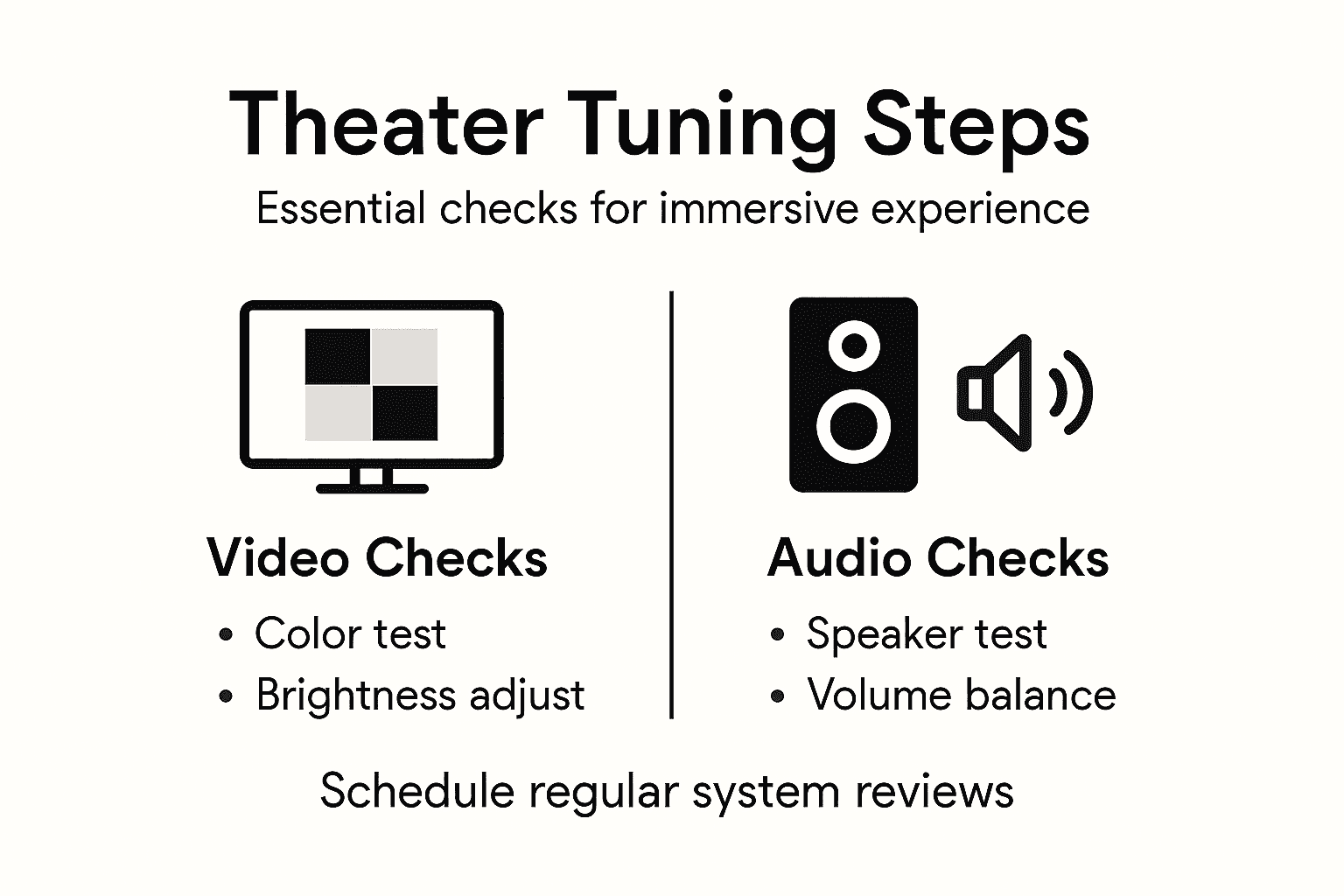
Invite a small group of trusted friends for a test screening. Watch their reactions and gather honest feedback. Do they notice the screen? Does the audio feel immersive or distracting?
Testing immersive environments involves iterative evaluations focusing on user interaction and sensory synchronization. Their genuine responses reveal what your eyes and ears might miss after weeks of installation work.
Document specific issues during testing:
- Audio dead zones where surround speakers don’t reach
- Screen reflections from unexpected light sources
- Automation timing problems (like shades closing too slowly)
- Subwoofer placement causing boomy or weak bass
- Sight line problems from certain seating positions
- Temperature fluctuations during extended viewing
Optimization focuses on enhancing engagement, accessibility, and technological reliability through iterative adjustments. Make your adjustments methodically, changing one variable at a time so you understand what actually improves your experience.
Tweak your projector’s color temperature to match your preference. Adjust speaker levels until dialogue sits perfectly in the center. Fine-tune lighting scenes so they enhance rather than distract. Recalibrate your subwoofer placement if bass feels uneven across your seating area.
Opt for professional calibration if your system complexity warrants it. A technician can measure acoustic performance, verify speaker alignment, and optimize your projector’s color accuracy far beyond what most homeowners achieve independently.
Optimization never truly ends. Your theater evolves as you discover what works best for your specific space and viewing habits.
Schedule additional test sessions monthly during your first year. Small refinements compound into dramatic improvements over time.
Pro tip: Keep a simple notebook documenting every adjustment you make and how it affected the viewing experience—this prevents circular optimization and reveals which tweaks genuinely improved your theater versus which felt necessary but made no real difference.
Elevate Your Luxury Home Theater Experience Today
Designing an immersive theater that truly captivates requires more than just picking equipment. The challenge lies in seamlessly integrating advanced audio and visual solutions with smart home automation tailored to your unique space and entertainment goals. Whether you are aiming for a dedicated cinema with crystal-clear 4K projection and immersive surround sound or a versatile media room optimized for gaming and social events, addressing key pain points like perfect audio balance, precise lighting control, and intuitive automation is essential for emotional and sensory engagement.
At Atlanta Home Theater, our team of over 40 highly trained professionals has been crafting custom private cinemas and smart home solutions since 1996. We specialize in solving the exact challenges discussed in this article including acoustic treatment, balanced AV investments, and seamless control integration. Take advantage of expert insights from our
Sound Advice Archives and dive deeper into creating flawless home entertainment environments. Ready to transform your vision into reality? Visit
Atlanta Home Theater now to schedule your personalized consultation and begin crafting a luxury immersive theater that truly responds to your lifestyle.
Frequently Asked Questions
How do I assess my space before planning an immersive theater?
To assess your space, measure the room’s dimensions, ceiling height, and note any architectural features that may impact the layout. Walk through the space at different times of day to evaluate natural light and identify electrical outlets, aiming for a thorough understanding of how these factors will affect sight lines and sound distribution.
What are key considerations for defining my entertainment goals?
When defining your entertainment goals, consider who will use the space, what type of content you’ll primarily watch, and how often you’ll have guests. Write down specific objectives, such as hosting monthly movie nights or gaming sessions, to guide your equipment choices and budget effectively.
How should I balance my budget between audio and visual equipment?
A good rule of thumb is to allocate 40-50% of your budget to audio solutions to ensure sound quality matches visual performance. For instance, if your total budget is $20,000, consider investing $8,000 to $10,000 on audio for an immersive experience that complements your visuals.
What features should I look for in smart home automation for my theater?
Look for a central control platform that can integrate lighting, motorized shades, audio, and visual systems, allowing you to create automated scenes. Prioritize functions like lighting control and audio-visual synchronization to ensure your theater responds seamlessly to commands, enhancing the overall experience.
How can I test and optimize my theater experience after installation?
Conduct systematic testing of your components by playing test content to assess audio and video performance, and invite a few friends for feedback. Document any issues you encounter and make adjustments methodically; for example, optimize speaker placement to improve surround sound, aiming for noticeable enhancements within a few test sessions.
Recommended
